
The Case for Fractional Communications Leadership in Complex Organizations
- debbief@creativetechresources.com

- Apr 22
- 2 min read

As stakeholder complexity increases, organizations default to two models: full-time leadership or contractors for execution. Increasingly, neither resolves the underlying issue—alignment and execution at scale.
A third model is emerging: fractional communications leadership, which delivers senior-level impact with precision, flexibility, and speed.
Research from McKinsey & Company shows that organizations with strong alignment across strategy, leadership, and execution are more than twice as likely to outperform peers, yet most struggle to sustain that alignment over time.Source: Organizational health is (still) the key to long-term performance
Alignment doesn’t happen on its own. It must be intentionally created, translated, and sustained through communication.
This is the gap. Fractional communications leadership closes it.
The Core Distinction: Execution vs. Ownership
The difference isn’t time commitment. It’s ownership.
Contractors complete work. Fractional communications leaders ensure the work matters, and deliver results.
Contractors are execution-focused.
Deliver defined tasks
Support campaigns and content
Fill short-term capacity gaps
They answer: What needs to get done?
Fractional leaders operate at a strategic level.
Define direction and priorities
Align communications with business strategies
Build systems and capabilities that scale and endure
They answer: What matters, why it matters, and how it drives results.
Why Organizations Are Shifting to Fractional
Three structural forces are accelerating adoption:
1. The Leadership Cost–Utilization Gap
Senior communications leaders are a significant investment, and often underutilized outside of major initiatives.
Fractional models provide on-demand access to executive-level expertise, without the burden of full-time cost.
2. The Alignment Advantage
Organizations that align strategy, messaging, and execution consistently outperform peers.
Research from McKinsey & Company shows that companies with strong alignment are up to 2x more likely to outperform in both execution and overall performance.
3. The Execution Gap
Most strategies don’t fail because they are wrong; they fail in execution.
Research published in Harvard Business Review indicates that up to 67% of strategies fail due to poor execution and lack of alignment.
Fractional communications leadership closes this gap by translating strategy into aligned, sustained execution.
These forces are not temporary. They reflect a structural shift in how organizations access and apply leadership.
What Fractional Communications Leaders Do
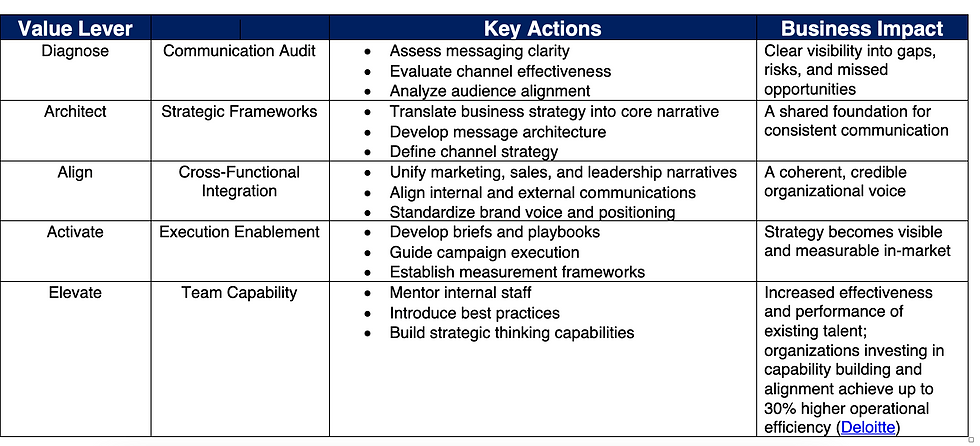
High-impact fractional leaders focus on five critical levers that drive impact:
The Multiplier Effect
Fractional leadership is not additive; it is multiplicative.
It turns strategy into action, teams into alignment, and execution into results, unlocking more value from existing resources.
When Fractional Is the Right Model
It is most effective when direction is unclear, messaging is fragmented, growth is accelerating, or leadership capacity is constrained.
Contractors increase output. Fractional leaders increase impact.
If your organization is executing but not seeing results, the issue isn’t effort, it’s alignment.
Creative Technical Resources helps organizations diagnose communication gaps, align strategy, and turn initiatives into measurable outcomes.
If you’re ready to move from activity to impact, let’s start the conversation here.


Comments